Thursday, 24 May 2012

Soldier, Sailor


Africa, as a continent, but more as a concept, ideal or set of values, gives the context for capoeira. There is a more recent history that is also communicated through the songs and movements of capoeira. This is a history of heroic capoeiristas and their – often military – exploits, and of ordinary capoeiristas and their daily lives.
From Africa, with sunshine!
I got back to Salvador from Kilombo Tenonde and found a postcard from a friend in Madagascar! It took a month to arrive and seems to be evidence of a big world out there!


Warriors

There are a few songs in capoeira that are traced to military battles. Paranaé – perhaps the most widely sung capoeira song – references the involvement of slaves in the war against Paraguay (1865-70) in which many capoeiristas were enlisted.

The participation of capoeiristas in historic battles places them central to the history of Brazil – and as a function of their martial art, which was illegal at the time. This was also a moment of liberation: capoeirstas were promised freedom on the misplaced assumption that they would not survive the fighting. The song: “I won the battle of Camugerê,” also recalls a victory; in this case runaway slaves killed the slave master who was pursuing Aidê, an African enslaved woman. The recounting of these stories locates capoeira politically – in opposition to the state and slave masters. It also creates a heroic past in which capoeiristas’ exploits became decisive in their freedom from slavery.

There is a more radical critique of mainstream Brazilian history relayed by capoeira songs that debunk of the myth that slavery was abolished by the Golden Law of 1888. The argument is put succinctly in the ladainha ‘Dona Isabel, que historia e essa?’ (Madame Isabel, what history is this?). The ladainha offers an explicit counter-narrative: freedom was not given by Princess Isabel; it was Zumbi who fought for the true freedom, training heroes in the runaway settlement of Palmares. A similar line is given by the ladainha ‘Zumbi, King of Palmares,’ which begins, “history deceives us, telling us the opposite of what happened…” and elsewhere, sometimes mixed with the – contradictory – assertion that slavery has never been abolished.


Zumbi dos Palmares, statue in the Pelourinho, Salvador


Plaque by the statue


Workers
 
Vou vender coco, senha
A larger body of songs refers directly to the everyday lives of capoeiristas: not having the gravitas of the references to slavery or war, these more incidental histories tend to be rendered in the corridos, which are the simple songs that are sung during the roda and have a call-and-response structure. Market traders, cowboys, plantation workers, petty craftsment, dockers and sailors are represented in song. With the exception of ‘espora’ – ‘spur’, the names of moves are not derived from jobs. Cowboy songs also have direct reference to the game: ‘lasso, lasso, cowboy’ indicating the moment to strike. There is some sedimentation around the first half of the 20th century. No one is working as a call centre or a petrochemicals factory.

There is a range of trades but they are all labouring jobs: there are no bureaucrats or property owning classes in capoeira songs. The jobs cited demand bodily strength, and Nancy Scheper-Hughes notes that people who have physical work are more likely to express themselves somatically (Scheper-Hughes 1992, 187). The shapes of the moves in capoeira are expansive and demonstrative of physical form: they are devised by labourers, not by people sitting at computers or driving cars.

women in the roda (from Alexandre Robatto’s 1954 film
‘Vadiação’; photos displayed in Forte de Santo Antonio)

Practically all capoeira songs present the male perspective, reflecting the predominantly male history of the game, a predominance that continues particularly in the upper echelons of the game. There are references to female Orixás and occasionally to their associated female saints. There is also a palpable female human presence: there are very few romantic love songs, but women appear in the everyday of life. There are women market traders, there are women’s names in songs ‘sai sai Caterina’ (leave, Caterina); ‘Dona Maria, como vai voce?’; (Maria, how are you?) ‘Dona Alice, nao me pega nao,’ (Alice, don’t get me) or more generally, ‘menina,’ ‘nega,’ ‘morena,’ or ‘mulher’ – terms addressing or referring to women.


Salvador-on-Sea

An important set of references is also made to Salvador, Bahia, the home of capoeira. There are a few mentions of Brazil (usually as the country that abolished – or didn’t – slavery), but the immediate geographical environment is frequently the subject of songs. You can literally (yes, literally) sing your way round Salvador: ‘Bahia de todos os santos’; ‘Good Jesus of Lapa!’ (an area of Salvador); ‘I’m going to Maré Island’; ‘If you want to see me, go to Piedade [Square] tomorrow’; ‘Adeus Santo Amaro’ (a town near Salvador).

Bom Jesus de Lapa-eh!
Sao Bento me chama
Saia do mar, marinheiro!


Bahia de Todos os Santos

The sea is also a constant presence in songs: as a source of fear and fish, as a vector for journeying and the source of sunken treasure, the preserve of the Orixá Yemanja, and as a feature of the city. It is also where the sting-ray lives, the ‘sting-ray’s tail’ – raba-de-arraia, being the name of a spinning kick. There is something very beautiful about playing in a roda by the beach singing, ‘Aprendi a jogar capoeira de Angola na beira do mar’ – ‘I learned to play capoeira Angola by the edge of the sea.’

The message

The perspective relayed through movement and songs is a workers’ perspective. There is not a strong class-consciousness or a unified political ideology, but there is a strong recognition of roots and social context.

References to Salvador and Bahia and the lives of extraordinary and ordinary people who live here sit within the broader context of Africa and slavery and provide local roots to capoeira. The relaying of experiences and familiar places establishes a bank of shared knowledge, experience and identity. Capoeiristas come from the street, are workers and – despite all the talk of travelling – really rather like Bahia (it’s lovely!).


References:

Scheper-Hughes, N. (1992). Death without weeping. The violence of everyday life in Brazil. Berkeley, Oxford, University of California Press.


Thursday, 10 May 2012

´AFRICA´


You can find very similar instruments
 in the National museum in Kinshasa, Congo
The big news story is the waves. In the past week they have gone from being small and friendly to huge and very friendly. Apparently it’s now winter (it’s still extremely sunny!)


In this and the next few blogs, I’ll be presenting the knowledge that is transmitted through capoeira – the cognitive ends of the extralinguistic communication – and considering how it relates to communicative and instrumental rationality.


This blog will be looking at the references that are made to Africa and slavery, and that iteratively acknowledge these origins in capoeira and in Brazilian history. I put the word ‘Africa’ in inverted commas as the name does not refer to the continent in historical or geographical terms. Instead, a notion of ‘Africa’ is forged by capoeira that serves social and political functions.


According to the Afro-Brazilian Museum in Salvador, 4,507, 940 Africans arrived in Brazil as slaves from the beginning of Portuguese colonisation until 1851. Thousands more died en route. By way of comparison, a similar figure is put on the excess mortality rates in Congo during the wars from 1998-2002.

A double-headed agogo from Benin
 - in the Afro-Brazilian museum, Salvador


Off-shoots

 A ladainha from Mestre Pastinha’s CD includes the lines, “Capoeira came from Africa. It was the African who brought it” (CD Mestre Pastinha/ FICA songbook p6).

 
There are elements of capoeira that can be regarded as ‘off-shoots’ of Africa: the instruments, the roda, the call and response singing, the incantation of ‘Iê!’. Combat games were played in parts of central and southern Africa before colonisation.


 That there are elements of African culture is not contentious: until the 1930s, capoeira was played almost exclusively by people of African descent. Music was introduced probably around the beginning of the 20th century, and as Brazilian social life was segregated, it is not surprising that African instruments were used.


Invocation
  
Oxum
 There are more explicit references to Africa: the frequent invocation of Orixás (the divinities of the West African pantheon), and the notion of a numerous family and common ancestry that they inspire. Some songs have words that are understood to be ‘African’: Nzambe (God in Lingala), Aruanda (a spiritual home in various sects and religions such as Umbanda, Quimbanda and Candomblé), Benguela (a Angolan port). There are colloquial references to race or skin colour – which is always black.

There are direct references to slavery in songs. The first ladainha I learnt in Salvador was ‘Saudade do grande mestre’ – which reflects on the experience of being enslaved and brought to Brazil. Giving a personal account – albeit poetic – it recalls to the misery and confusion of the slaves, rather than simply the physical hardship or the injustice. Corridos refer to captivity, slave-masters and their families, and plantation work.

 
Xangô  - Orixá of thunder and fire.
Xangô in capoeira is a backflip

There are also many songs and moves that refer to a natural environment – there are frequent references to the moon and the sun which, along with religious citations, summon a cosmic, rather than a human, order. A jungly context is given by ubiquitous mentions of forests and animals in the names of moves and in songs: monkeys, frogs, scorpions and various bird species.


Jungle cookies

In Guyana, you can buy jungle cookies. They don’t come form the jungle, though – they are baked in a factory but cut to look like jungle animals.

The Africa mix is compiled in Brazil. Orixás and agogos come from West Africa, berimbaus and atabaques (drums) come from central Africa. The pandeiro came with the Portuguese; practically all capoeira lyrics are Portuguese. And ‘Angola’ comes from Mestre Pastinha, the founding father of Capoeira Angola.

Berimbaus & pandeiro – (from Alexandre Robatto’s 1954 film ‘Vadiação’;
photos displayed in Forte de Santo Antonio

  
 People were brought for slave labour from Angola, but also Congo, and from West Africa – the Yoruba and Evê-Fon kingdoms. Angola is constantly invoked in Capoeira Angola songs; no other African countries are mentioned (the only exception I have come across is a corrido that relates: ‘I left Congo, I went to Angola!’). There is very occasional reference made to ‘Bantu’ which is commonly understood to include Congo and Angola, but comprises a much larger area.


What is more, slaves were brought from the interior and would not have national Angolan identity (not least because the territory was not fully established until after the end of slavery). Nor would they sing about Luanda, now the capital city, but then essentially a slave port. Slave identities would relate to kin or kingdom groups, and the lack of reference to these names is poignant: slavery disoriented heritage, and reference to broad and imposed identities, such as ‘Angolan’ preserves the dislocation of slavery rather than the more complex political reality from which people were brought.

Map showing slaving routes,
in the Afro-Brazilian museum in Salvador

Yansa


Exu


If we look at the jungle scenes, we find that they are not African – the animals are South American: there are jaguars in songs not lions, cutias (a South American chipmonk) not gibbons, caimans not crocodiles. Beija-flor – the hummingbird/ one-handed handstand – lives only in the Americas. ‘Macaco’ (or ‘macaque’ in French) has an offensive colonial legacy, particularly in Congo where the Belgians referred to uneducated ‘non-evolved’ Congolese as monkeys. ‘I stepped on a dry leaf and heard it crunch’ is a story about a runaway slave concerned that the noise made by the dry leaves will give him away.

Xango


Where is Africa?

The notion of African culture, words or ancestors provides a uniting discourse for a consciousness of slavery. References to Africa have communicative rationality in establishing a base and with it a lineage and capoeira community.


It´s difficult in the city
This non-literal concept of Africa performs social and political functions. It is the watchword for the motherland and black consciousness. Africa is the refuge, the home. Lacy talks of the ‘tame zones’ of security and modernity – oppositional to the ‘wild zones’. But the wild zones of the jungle are not threatening to all; Africa is the nurturing jungle where alternative norms, hierarchies and laws exist. In capoeira, Africa (or Angola) establishes a counterpoint to the tame zones of modernity. By reference to these origins, which legitimize and provide historical significance to capoeira, an alternative way of life is established through the processes of musical, lyrical and somatic communication.


Ossayin

Africa is not somewhere that has been left behind. It is the other side of the kalunga – the middle passage – that continues to exist in people’s identity, religious beliefs and artistic expressions. It is the other side of death, where the ancestors live and provide guidance and protection. It has a historical function in granting meaning and continuity. But its significance is also in a continued presence: this is what makes capoeiristas who they are. And Africa is the future too: frequently it is where capoeiristas are just off to ‘I’m going back to Angola’ – to play capoeira!
Orixas by Carybé, displayed in the Afro-Brazilian museum in Salvador 


Oxossi


References:

Lacy, M. J. (2003). Security and climate change : international relations and the limits of realism. London, Routledge.


Thursday, 26 April 2012

No such thing as too much capoeira (life!)

“Dona Maria from Camboatá
She arrives at the market and bosses people around
She arrives at the roda and does a backward summersault”

This is my final ‘introductory’ blog. It’s to explore the relationship between capoeira and life as this has many dimensions and is relevant when considering the ways in which security has been distributed through capoeira. For those who play, capoeira is engrossing and taxing; but more than that – it becomes conceptually linked to practically all other elements of life.


It’s about time

Playing capoeira

Training takes a lot of time and cuts out various other things (meals, alcohol…). Rodas (games) in Salvador tend to take place on Fridays, Saturdays and Sundays – so capoeira takes over your social life too. Capoeira makes you stronger, more flexible and fitter. It consumes parts of your brain, so when you’re not training, conversations turn to how to do things faster, slower, more beautifully, more tricksily. Lots of corridos (capoeira songs) are about the game or the instruments – ever decreasing circles!

This much is not unique to capoeira; many sporting or leisure activities develop absorbing communities, although capoeira’s range of skills – from acrobatics to ritual to musicality – is particularly demanding. The conceptual links, though, are more profound. As I write this blog, I am swiping at a mosquito. The mosquito retreats, flies round, makes another approach. It feels like capoeira. Capoeira affects your relationship with your body, with time, and with others. It is part of every other game, every other struggle and every other dance.

When considering the distribution of security, the use of tactics and strategy, the force of creativity and expression and the generation of identity are not boarded up inside the game or extracted from life and transposed to a playful setting. It is much more integrated than that. Capoeira maintains a duality – as a game and as a way of life – as is regularly acknowledged by capoeira teachers and in songs.

I have just caught the mosquito.

In his book, Ring of Liberation, Lowell Lewis discusses capoeira as reflection on life and escape from it, simultaneously a space for forgetting and for acknowledging.


Reflection on life


Come on in - the water´s lovely!
“Quem não sabe nadar vai ao fundo” “whoever doesn’t know how to swim sinks to the bottom”

Capoeira’s moves and music reflect on life and, to a large extent, on brutal aspects of life. Reflections on slavery are pervasive in the ladainhas (the long songs that are sung at the beginning of a roda), as are reflections on the fickleness of life and power and the need for deceit and trickery.

The movements of capoeira have violent elements, embodying not a role-play of oppression and liberation, but a somatic reflection on it. In line with Bourdieu’s law of the conservation of violence, the kicks are real, even though the context is ritualised. The movement establishes a somatic discourse. Faber writes, “The centrality of the body to ritual means that “ritualization” is a particularly mute form of activity. It is designed to do what it does without bringing what it is doing across the threshold of discourse or systematic thinking” (Faber 2004, 110). Capoeira repeats and repeats its references to violence and freedom without articulating experiences or opinions.


Escape from life

Capoeira is also an escape from life. It provides community, conventions, and hierarchies that, even if they are not completely safe, at least set customary parameters. According to Miller, “Common understandings arrived at consensually provide the basis for a morally valued way of life and the construction of collective identities that transcend the individual” (Miller 1992, 29). The roda is a place of camaraderie: people greet each other, sing together, respect the art, and end games with a hug.

Capoeira allows adepts to play around: they express, create and imagine – the words ‘jogar’, ‘brincar’ and ‘vadiar’ capture different elements of play. It is pursued with a kind of religious tenacity: in the 19th century people risked being whipped or incarcerated for playing capoeira, but it did not stop them. Many songs talk of being ‘called’ to capoeira (and sometimes beaten or killed by it!). Sometimes it is the berimbau calling, sometimes Angola, sometimes Saint Bento – calling to play capoeira. There is also a freedom – of vagrancy and nomadism: songs state, ‘I’m off!’ – I’m going out to play capoeira, as if capoeira takes place a little apart from the usual cares of the world.

Escapism - only the blessed love cycling in Salvador


I’m already sick of living on the earth.
Oh, Mum, I’m going to the moon.
I told my wife and she replied,
“We’ll go if God is willing” 
(ladainha from CD Mestre Pastinha/ FICA songbook p6)


‘Jogar o jogo da vida’ – to play the game of life

And despite all the reflection and escapism that capoeira offers, the politics of its day-to-day administration is as divided and mundane as any other group activity. There are disputes within groups and between them. Groups tend to acknowledge the legitimacy of their mestre and lineage rather than submitting to an overarching authority.

What counts as capoeira, the names of the moves, interaction with different styles provided grounds for little agreement through the 20th century. The pressures of globalisation, the need to attract students, the struggle of making a living from art are worldly concerns that contribute to the dimensions of the relationship between capoeira and life.


Contradictory, as is life


Contradictions - what´s not to like?


Equilibrium in capoeira is not static with both feet planted on the floor but fluid and responsive. Capoeira maintains contradictions – of deceit and camaraderie, of hanging out and discipline, of fighting and playing, of equality and hierarchy, of authority and resistance, of united struggle and internal division. It is all very contradictory. Life can be like that.

When I die
I don’t want crying or mystery.
I want a berimbau playing
At the gate of the cemetery
With a yellow ribbon round it.
(ladainha from CD Mestre Traíre/ FICA songbook p5)


References:

Faber, A. (2004). Saint Orlan. Ritual as violent spectacle and cultural criticism. The Performance Studies Reader. H. Bial. London and New York, Routledge: 108-116.

Fundação Internacional de Capoeira Angola/ International Capoeira Angola Foundation (FICA/ICAF), Livro de Músicas (Ladainhas/Corridos), in-house publication.

Lowell Lewis, J. (1992). Ring of Liberation: deceptive discourse in Brazilian capoeira. Chicago, The University of Chicago Press.

Miller, B. (1992). "Collective action and rational choice. Place, community and the limits to individual self-interest." Economic Geography 68(1): 22-42.

Thursday, 12 April 2012

All comms open


Investing in the myth

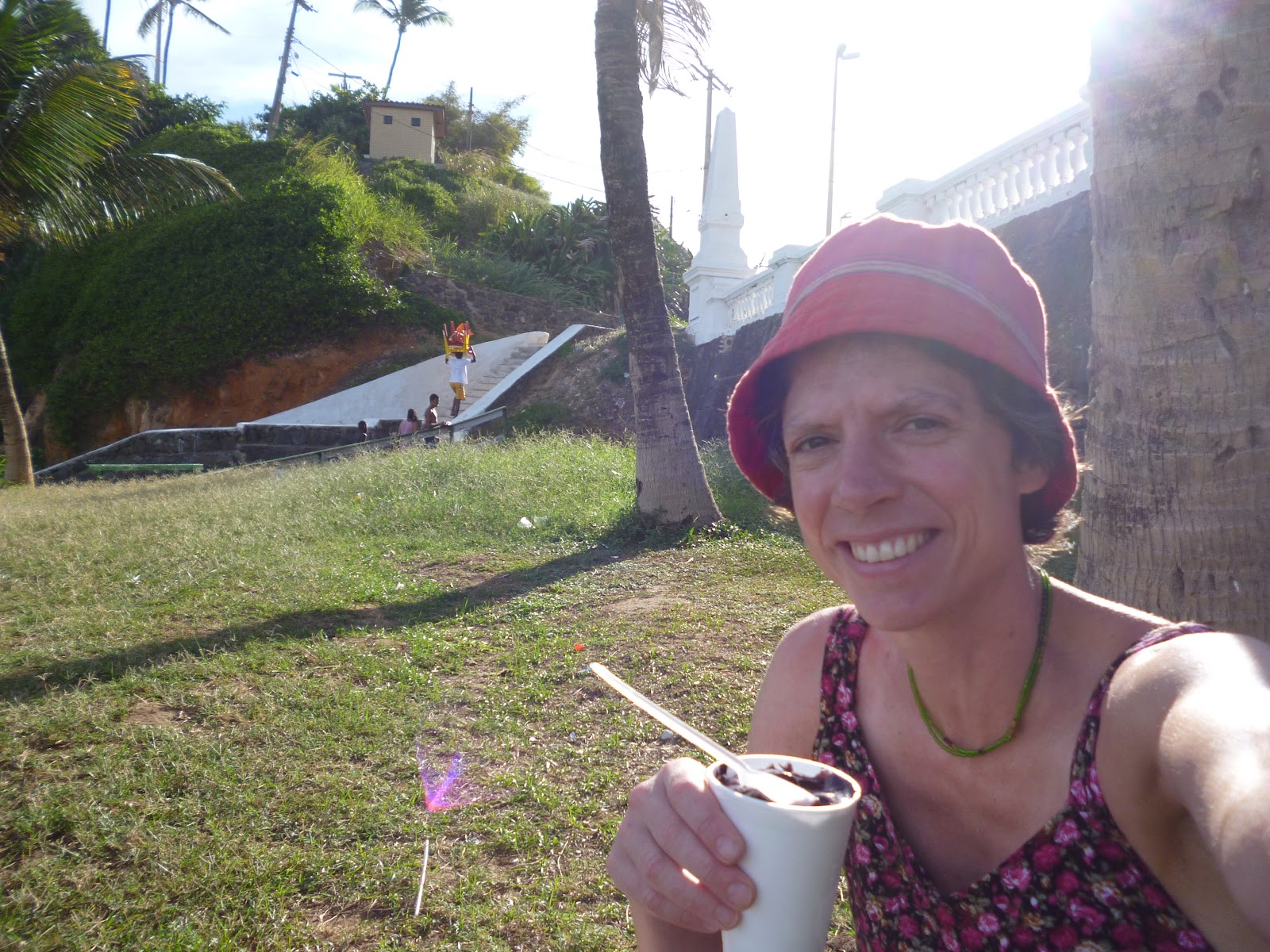
The Easter break imposed a three day stay of capoeira! Also, my computer charger broke. So I was left just with sunshine, sea and a little more than a litre of acaí (which is like ice cream and, apparently, very good for you!)


This blog develops my thoughts on how to understand capoeira.

Political games

Where people find meaning and happiness is political territory. Many games have social and political functions and have been subjected to state intervention and regulation. In Afghanistan, buzkashi, a form of horseback hockey played with a goat’s carcass has been the centre of negotiation and compromise between the state and players (Azoy 2012). Geertz, in his analysis of state attempts to control play, examines Balinese cockfighting. He records, “[the elite] sees cockfighting as ‘primitive,’ ‘backward,’ ‘unprogressive,’ and generally unbecoming an ambitious nation. And, as with those other embarrassments – opium smoking, begging, or uncovered breasts – it seeks, rather unsystematically, to put a stop to it” (Geertz 1972, 2). In the early 20th century, capoeira – along with other manifestations of Afro-Brazilian culture – was regarded in much the same way by the Brazilian state.


First step – cover your breasts

Geertz notes that to see Balinese cockfighting as a rite or pastime obscures its ‘use of emotion for cognitive ends’ (Geertz 1972, 27): knowledge is generated through emotional – specifically ‘non-rational’ – means. This is a helpful starting point for analysing capoeira as the dance, fight and game elements provide simultaneous emotional markers.


What are the cognitive ends of capoeira and how are they transmitted? There are no written accounts from the quilombo runaway slave settlements where capoeira developed and many of the documents on slavery were destroyed as the Brazilian state tried to dissociate itself or deny its past as a slave colony. Conquergood quotes the Comaroffs as asking: “do we still have to remind ourselves that many players on any historical stage cannot speak at all? Or, under greater or lesser duress, opt not to do so” (Comaroff & Comaroff 1997, 48). He writes,
“Oppressed people everywhere must watch their backs, cover their tracks, suck up their feelings, and veil their meanings. The state of emergency under which many people live demands that we pay attention to messages that are coded and encrypted; to indirect, non-verbal, and extralinguistic modes of communication where subversive meanings and utopian yearnings can be sheltered and shielded from surveillance” (Conquergood 2004, 314).

To understand the perspective of those who have been oppressed, we need to find ways of accessing and decoding these encrypted and subversive meanings.

Extralinguistic cognition

Grasping the cognitive ends of extralinguistic communication is something we do all the time. Take music, for example. We have all gained knowledge from listening to music: we have learned tunes, lyrics and stories. Anyone who has learnt an instrument has done so largely through practical example. Also, there are ends beyond the technical: those who play or write music know the totally disproportionate and broadly inexplicable happiness that it gives, and the emotional or political potency of expressing and creating unencumbered by written prose.

Music therapists Andsell and Pavlicevic draw on Trevarthen’s notion of “Communicative musicality… [which] is the dynamic sympathetic state of a human person that allows co-ordinated companionship to arise” (Andsell & Pavlicevic 2005, 195). ‘Co-ordinated companionship’ in capoeira arises between the teacher and student, between players – the game of capoeira is similar to a conversation – and within the roda, between the batería (the musical accompaniment) and players. Communication is not simply about sending messages, but takes place according to an ‘orchestral model’ whereby ‘coactivity, harmonization and co-regulation in context define the process of communication as meaning created or shared.” This renders communication a “social phenomenon, where the meaning of any musical utterance lies within the context of its social use” (Andsell & Pavlicevic 2005, 199). In capoeira, companionship within groups and across groups is established through somatic and musical references and in-jokes, and also across time as knowledge is embodied in moves and songs that are transmitted through the lineage of the group.

Security: Attunement

The movements, melodies, rhythms, lyrics and rituals of capoeira provide diverse channels for cognitions to be transmitted – all communications are open. Andsell and Pavlicevic assess not only the attunement – the process of copying – but also the ‘carefully judged mis-attunements’ which extend repertoire. They cite Keil’s notion of ‘participatory discrepancies.’
“[Keil] writes that ‘music, to be personally involved and socially valuable, must be ‘out of time’ and ‘out of tune’. The ‘groove’ of music is its attuned flow, but the aliveness of the musical communication between the musicians depends on how they play around the set-up expectations” (Andsell & Pavlicevic 2005, 202).

This has particular resonance for capoeira, as trickery and deception – confounding the expectations of the other player – are central to the game.

Letting it out!

Capoeira is improvised but, like musical genres of improvisation, it is not random. The movements and music provide adepts with cognitive tools not only for representation but also for self-representation and expression. Arnold Davidson’s work on jazz improvisation is instructive. Arguing that improvisation reflects on ethics, he “makes reference to the ancient tradition of self-realization through rational inquiry, or ‘care of the self,’ to explore the relation between self and other in the process of collective improvisation.”

By playing capoeira, adepts take part in capoeira’s history and develop an awareness of their part within it through their performance. (‘Performativity’ is explored in gender studies: people understand gender through the process of taking gender roles. In a similar way, capoeiristas understand capoeira through the process of playing). The ‘co-ordinated companionship’ established forges a communicative rationality in generating and reinforcing personal and group understanding and identity, and with it a vector of security. 

The diverse forms of extralinguistic communication grant access to various themes and conventions that establish the parameters on capoeira’s discourse. An understanding of this discourse – an appreciation of the cognitive ends of capoeira – can be achieved by examining not only the content of these themes and conventions but also their meaning, political force and the spark that makes capoeira so much fun.


References:

Ansdell, G. & M. Pavlicevic (2005). Musical Companionship, Musical Community: Music therapy and the processes and values of musical communication. Musical Communications. Hargreaves, North & MacDonald. Oxford Oxford University Press: 193-213.

Azoy, G. W. (2012). Buzkashi: Game and Power in Afghanistan (Symbol and Culture). Illinois, Waveland Press.

               
Conquergood, D. (2004). Performance Studies. Interventions and radical research. The Performance Studies Reader. H. Bial. London and New York, Routledge: 311-322.

Geertz, C. (1972). "Deep play: Notes on the Balinese Cockfight." Daedalus 101(1): 1-37. http://www.jstor.org/stable/20024056.